The 2-Minute CEO Update: A Tech Lead’s Playbook for Production Outages
Learn the Situation-Impact-Request (SIR) framework to maintain executive presence and manage up during high-pressure production outages.
Your heart rate is 110 BPM. The engineering "war room" is silent, except for the frantic clicking of keyboards. Then, your phone vibrates. It’s a DM from the CEO: “What’s the status? How bad is this?”
Most system outage communication plans focus on the customers. They give you templates for status pages and Twitter updates. But they ignore the most high-stakes conversation of all: Managing up during a production outage.
If you go into a technical rabbit hole, you lose them. If you sound anxious, you lose their trust. You need a communication protocol, not just an update.
The Problem: The "Technical Rabbit Hole" Trap
When the site is down, the CEO doesn't care about a database shard or a memory leak. They are trying to calculate business risk.
The biggest mistake Tech Leads and PMs make is over-explaining the how before addressing the what. This leads to follow-up questions that feel like micromanagement, further spiking your anxiety. To maintain executive presence, you must decouple your technical investigation from your executive communication.
The Solution: Two Protocols for Two Realities
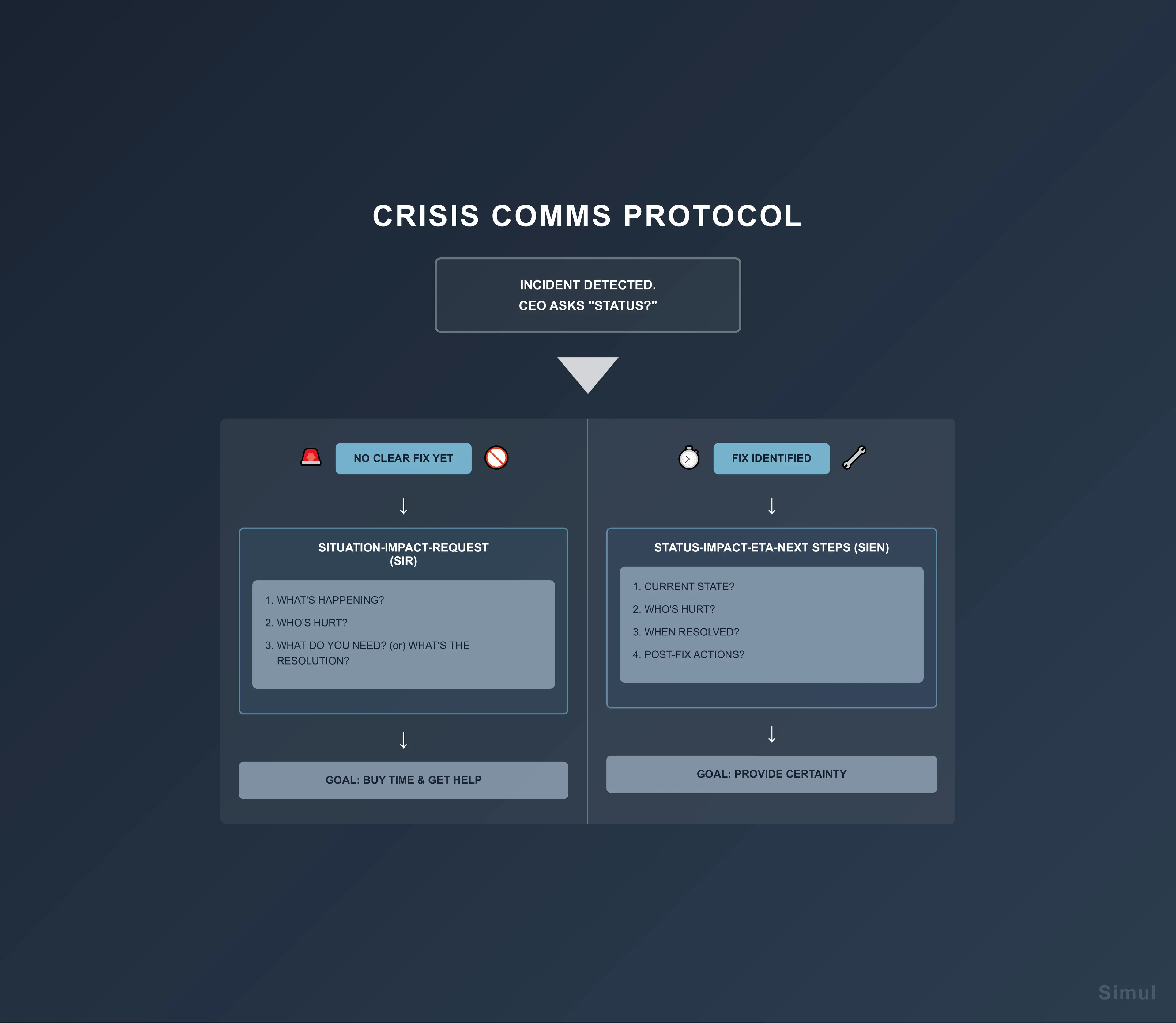
Structured communication beats "winging it" every time. Depending on the state of the incident, you should pivot between these two frameworks.
Scenario A: You are still identifying the issue (The SIR Framework)
If you are in the middle of the "fog of war" and need space or resources to work, use Situation — Impact — Request.
- Situation: "We are seeing a 50% drop in checkout completions globally."
- Impact: "This is currently affecting all web users; mobile is stable but slow."
- Request: "I need 15 minutes of silence from the leadership channel to finish the rollback. I will update you at 2:15 PM."
Scenario B: You have identified the fix (The SIEN Framework)
Once the "Why" is found, the CEO only cares about "When." Use Status — Impact — ETA — Next Steps.
- Status: "We’ve identified a bad deployment in the payments service."
- Impact: "The fix is being verified now; no data was lost."
- ETA: "We expect recovery within 12 minutes."
- Next Steps: "Once back up, we’ll monitor for 30 minutes and I’ll send a summary."
Why Delivery Matters More Than the Template
You can have the best incident reporting for executive leadership on your screen, but if your voice shakes or you use 50 "ums" and "uhs," the CEO hears uncertainty.
Executive presence for engineers isn't about being a "polished speaker"—it’s about being a steady signal in a noisy environment. The framework provides the logic, but your delivery provides the confidence.
Common Anti-Patterns to Avoid:
- The "Maybe" ETA: Never say "It should be fixed soon." Give a hard time, even if it’s a window.
- The Over-Apology: You don't need to apologize five times while the site is down. Fix it first. Apologize in the Post-Mortem.
- The Jargon Barrier: If you have to explain what a "Kubernetes Pod" is during a P0, you’ve already lost the room.
Master the Crisis Before it Happens
Frameworks are easy to read but hard to execute when the building is metaphorically on fire. You don't want the first time you use Situation-Impact-Request to be during a real $10k/minute outage.
At Simul, we’ve built the first soft skill simulator for tech leaders. Our Voice Labs allow you to roleplay this exact scenario—dealing with a stressed CEO during a production outage—using an AI-powered voice agent. You get real-time feedback on your brevity, tone, and framework adherence.
Join the Voice Labs Waitlist
Stop 'winging it' with leadership. Practice your executive presence in a safe, simulated environment with our AI voice agent.
Written by Anantha Subramaniam
Product Manager & Founder of Simul